

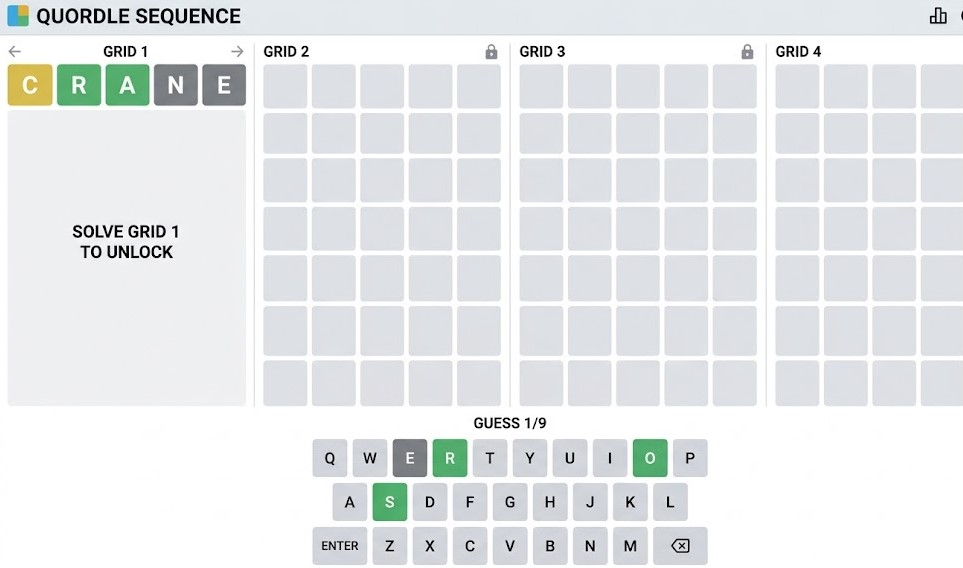
The quordle sequence mode offers a unique twist compared to the traditional Quordle gameplay by shifting the focus from solving four words at once to solving them one at a time in a fixed order. In the standard version, players can see all four grids simultaneously, allowing each guess to reveal clues across multiple words. However, in Sequence mode, only one grid is active at a time, and players must complete it before moving on to the next. This changes the entire gameplay dynamic, making it more structured and requiring greater focus on each individual word.
Another major difference is how strategy plays out in quordle sequence. Since guesses do not carry over across multiple grids at the same time, players cannot rely on shared letter clues to speed up progress. Every guess must be carefully considered for the current puzzle alone, which increases the importance of accuracy and efficient thinking. Additionally, because the total number of attempts is limited, wasting guesses early can make the later words much harder to solve. This makes Sequence mode more challenging in a strategic sense, rewarding players who think ahead and manage their guesses wisely.
How to Play Quordle Sequence (Step-by-Step Guide)
Playing quordle sequence is simple to understand but requires a thoughtful approach to master. The game begins with a single active grid where players must guess a hidden five-letter word. Just like other word puzzle games, each guess provides color-coded feedback—green indicates the correct letter in the correct position, yellow shows the correct letter in the wrong place, and gray means the letter is not in the word. Once you successfully solve the first word, the next grid unlocks automatically, and the process continues until all four words are completed.
To succeed in quordle sequence, players must manage their guesses carefully because the total number of attempts is shared across all four words. A smart step-by-step method includes starting with a strong opening word that covers common letters, analyzing feedback before making the next guess, and avoiding random attempts. As you progress through each stage, the difficulty often increases because you have fewer guesses remaining. This structured progression makes the game both challenging and rewarding, encouraging players to improve their vocabulary and logical thinking with each round.
Rules You Must Know Before Playing
Before diving into quordle sequence, it’s important to understand the core rules that define how the game works. The objective is to solve four different five-letter words, but unlike the standard version, you must complete them in a fixed order. Only one puzzle is visible at a time, and you cannot skip ahead. Each guess must be a valid five-letter English word, and the familiar color feedback system—green, yellow, and gray—guides you toward the correct answer. These basic rules may seem straightforward, but they form the foundation of a more strategic gameplay experience.
Another key rule in quordle sequence is the limited number of total guesses shared across all four words. This means you cannot afford to waste attempts on random or careless guesses, especially in the early stages. If you use too many tries solving the first or second word, you may find yourself with very few chances left for the remaining puzzles. Additionally, once a word is solved, you cannot revisit it, so accuracy is crucial at every step. Understanding and respecting these rules will significantly improve your chances of completing all four words successfully.
Best Starting Words and Strategies
Choosing the right opening word is one of the most important steps in mastering quordle sequence. Since each guess only applies to the current word, your first move should focus on maximizing letter coverage rather than guessing randomly. Words that include common vowels and frequently used consonants—such as A, E, R, T, L, and S—can quickly reveal useful clues. A strong starting word helps you identify correct letters early, reducing the number of guesses needed and preserving attempts for later stages of the game.
Beyond the first guess, a smart strategy involves analyzing feedback carefully and adapting your approach with each move. Instead of repeating similar letters or guessing blindly, players should aim to test new letter combinations while refining known positions. In quordle sequence, efficiency matters more than speed, so every guess should serve a purpose. It’s also helpful to avoid overcomplicating early guesses—focus on clarity and information gathering first, then narrow down possibilities as you progress. By combining strong starting words with thoughtful decision-making, players can significantly improve their overall performance.
Advanced Tips to Win Consistently
To consistently succeed in quordle sequence, players need to move beyond basic guessing and develop a more refined, strategic approach. One effective technique is to prioritize letter positioning early in the game rather than just identifying correct letters. For example, once you discover a few correct letters, focus on rearranging them efficiently instead of testing completely new ones. This helps you solve each word faster and preserves valuable guesses for later rounds, where the challenge becomes more intense.
Another advanced strategy involves managing your remaining attempts wisely across all four words. In quordle sequence, it’s not just about solving one puzzle—it’s about pacing yourself through the entire sequence. Skilled players often aim to solve the first word in as few guesses as possible, giving themselves a buffer for the remaining puzzles. Additionally, keeping track of previously used letters in your mind can prevent repeated mistakes and improve accuracy. Over time, practicing these techniques will enhance both your speed and precision, making it easier to complete all four words successfully.
Common Mistakes Players Should Avoid
Many players struggle with quordle sequence not because the game is overly complex, but because of avoidable mistakes that reduce efficiency and waste valuable guesses. One of the most common errors is making random guesses without analyzing feedback properly. Since each attempt is limited, guessing without a clear strategy can quickly drain your available tries, especially in the early stages of the game. This often leads to difficulty completing later words, even if the first one is solved correctly.
Another frequent mistake is ignoring letter patterns and repeating the same ineffective approach. In quordle sequence, every guess should provide meaningful information, yet many players fail to adjust their strategy based on previous results. For example, continuing to use letters that have already been marked incorrect only slows progress. Some players also focus too much on solving quickly rather than accurately, which often leads to unnecessary errors. Avoiding these habits and focusing on thoughtful, data-driven guesses can significantly improve overall performance and success rate.
Benefits of Playing Quordle Sequence
Playing quordle sequence offers more than just entertainment—it also provides several cognitive and educational benefits. One of the biggest advantages is improved vocabulary. Since the game requires players to think of different five-letter words repeatedly, it naturally expands word knowledge over time. This makes it a great daily mental exercise for anyone looking to strengthen their English language skills in an engaging way.
Another key benefit is the enhancement of logical thinking and problem-solving skills. In quordle sequence, every guess must be carefully analyzed, encouraging players to think strategically rather than randomly. This improves decision-making abilities and helps develop a more structured approach to solving problems. Additionally, the sequential nature of the game promotes focus and patience, as players must complete one puzzle before moving to the next. Over time, these mental exercises can contribute to better concentration and sharper analytical thinking in everyday life.
Conclusion
In conclusion, quordle sequence is a highly engaging and strategic word puzzle that challenges players to think carefully, manage guesses wisely, and solve words in a structured order. Unlike the standard Quordle format, this version focuses on solving one word at a time, which adds a layer of discipline and planning to the gameplay. It is not just a fun daily challenge but also a great way to improve vocabulary, sharpen logical thinking, and enhance problem-solving skills. With the right strategies, smart starting words, and consistent practice, players can significantly improve their performance and enjoy a more rewarding experience.
The key to mastering quordle sequence lies in patience and smart decision-making. Avoiding common mistakes, learning from feedback, and applying advanced strategies can make a big difference in your success rate. Whether you are a beginner or an experienced word game player, this mode offers a refreshing and mentally stimulating challenge that keeps you engaged every day.
FAQs
1. What is Quordle Sequence?
Quordle Sequence is a word puzzle mode where players solve four five-letter words one after another instead of all at once.
2. Is Quordle Sequence harder than normal Quordle?
Yes, it is considered more strategic because you cannot see all words at the same time and must manage guesses carefully.
3. How many guesses do I get in Quordle Sequence?
You usually get a limited number of total guesses to complete all four words in order.
4. What is the best strategy for winning Quordle Sequence?
Start with strong vowel-rich words, analyze feedback carefully, and avoid random guessing to maximize efficiency.
For More Updates Visit: Biomagazine
