


A now-familiar social media scene begins with a simple street question: “How did you get rich?”. The answer may sometimes be enlightening, or sometimes sound almost like this:
Viewers are not only looking at watches, cars, or tailored coats. They are listening for a path. A short answer about sales, property, investing, or building a business can feel more useful than a glossy tour of a mansion because it sounds like a clue. The rich person is not just a symbol. They become a narrator of their own rise.
While Social Media Shows the Individual, Traditional Media Shows the Atmosphere
For decades, wealth on screen was built as a mood before it was built as a biography. Film and television did not always need to tell viewers exactly how a character became rich. A room could do that work on its own. Soft lighting, formal clothes, polished tables, measured speech, and a game played with total composure could signal status in an instant. Luxury was presented as an environment first. The audience was invited to absorb the feeling of distance, calm, and exclusivity that could be seen in an atmosphere of the most favorite game of film directors – baccarat.
That is why online baccarat gaming offers carry such a strong symbolic charge inside the wider language of luxury today – in the age of digitization, where the same game is no more in a physical casino but people still have the association with luxury even beyond the mobile screen.
Baccarat still carries the luxury signal
Baccarat has long worked as a visual shortcut for refinement because it feels selective and composed. In older screen storytelling, the baccarat room often stood in for a whole social class. A viewer did not need to know every rule of the game to understand what the image meant. The table, the silence, the posture, and the polish created an atmosphere of arrival.
How social media flips the old logic
Street interview content flips that logic. Instead of using a rich setting to imply a rich life, it uses a rich person’s voice to build the setting in the viewer’s mind. There is no need for a dramatic room, because the story itself does the work.
A creator asks one question on an everyday pavement, and the answer supplies the whole fantasy: first deal, first risk, first break, first million. Social media shows the individual, saying “listen to this person”, while traditional media shows the atmosphere, saying “look at this world.”
Why the Street Interview Format Feels So Hard to Ignore
These clips work because they compress several pleasures into one fast watch. First, they offer a status puzzle. People instantly read clothes, tone of voice, confidence, and setting. Second, they offer narrative payoff. The viewer gets a beginning, a turning point, and a result in less than a minute. Third, they create usable aspiration. A mansion tour can feel distant, but a direct answer about work, timing, or habits feels like information. The format turns wealth from a distant spectacle into a story that sounds almost transferable.
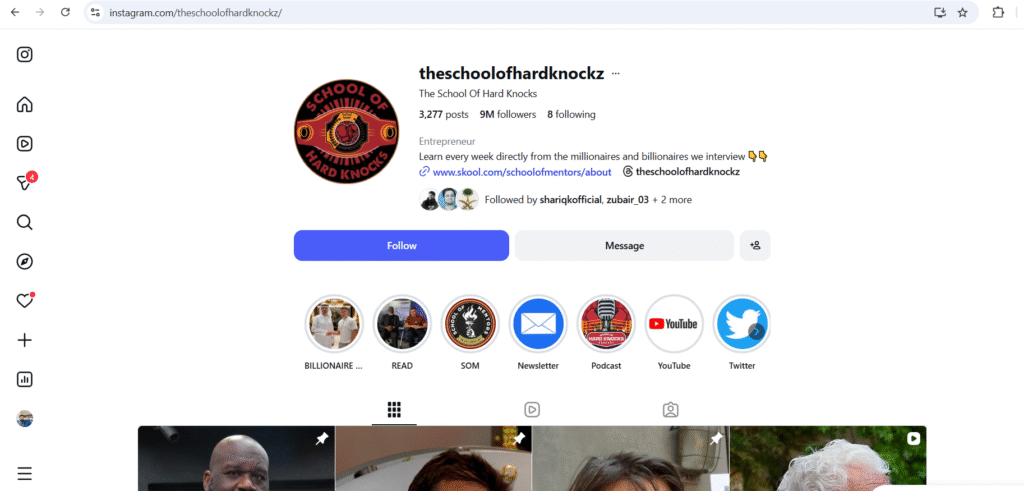
The School of Hard Knocks, which has posted thousands of interviews with rich and successful people, from Shaquille O’Neal to Tom Cruise, has more than 9 million followers on Instagram alone.
The deeper reason for their pull is that they satisfy curiosity without demanding much effort. A street interview feels casual, but it is highly efficient. It gives viewers the thrill of luxury and the comfort of explanation at the same time, hence the continuous progression of the luxury market. That balance matters in a crowded feed. People do not stop only for glamour but because glamour attached to a clear personal story feels more real, more useful, and easier to remember.
Why Viewers Want the Method Behind the Money
Part of the appeal is simple media habit. Reuters Institute reports that on social and video networks, 51% of young people say they pay more attention to individual news creators than to traditional news brands (39%).
There is also a deeper emotional reason. Many viewers are chasing reassurance. YouGov found that 75% of Americans say they have become more careful with money, while 37% of Gen Z and 34% of millennials say they plan to save more in the next year. At the same time, only 43% say they feel financially secure. In that context, “How did you get rich?” content works as a form of hopeful study, and even a textbook for those who want to save money or invest in stocks and elsewhere.
Humphrey Yang is one of the most-followed social media personalities who talks about finances, money management and stocks.

Luxury still matters, but its meaning is changing. Maybe that’s why a lot of people care more about experiences than about owning things.
That helps explain why these videos do not only show expensive objects. They also focus on freedom, travel, having control of your time, and daily life. The luxury item may catch people’s attention first, but the story of the life around it is what makes them keep watching.
The real secret of these short-form content is that they make wealth feel both distant and learnable.
