

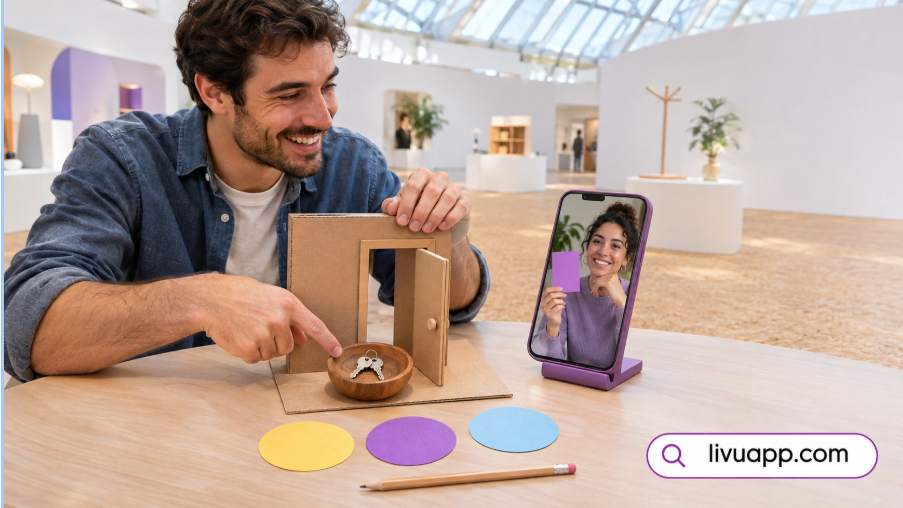
Daily routines are built from hundreds of small decisions. Where do we put our keys? How do we prepare for work? What happens during the first ten minutes after waking up? How do we remember to water a plant, take a break, or pack everything needed for the day?
Most of these systems develop by accident. They may work well, or they may include small frustrations that people have simply learned to accept.
The “tiny redesign challenge” turns one ordinary routine into a creative conversation activity. Two people each choose a minor part of daily life and work together to imagine a simpler, more enjoyable, or more unusual version of it. During a 1 v 1 video chat, they can describe the current routine, identify one difficulty, and sketch a possible improvement.
The goal is not to provide expert advice. It is to see an everyday habit from another person’s perspective and discover how differently people solve the same small problems.
Begin With Something Small Enough to Change
The best routine for this activity should be specific and low-stakes. “Improve my entire life” is too broad. “Stop forgetting my reusable shopping bag” is manageable.
Other examples include:
- Organizing a small desk before work
- Choosing clothes more quickly in the morning
- Remembering where keys were placed
- Taking regular breaks from a screen
- Preparing a simple breakfast
- Keeping a charging cable from becoming tangled
- Deciding what to cook after a long day
- Finding time to read a few pages
The challenge should avoid subjects that require professional expertise. Medical routines, financial planning, legal matters, and serious personal difficulties are not suitable for a casual redesign exercise.
An everyday inconvenience is enough.
Describe the Routine as It Exists Now
Before suggesting improvements, the person should explain the routine step by step.
Someone who frequently loses their keys might say:
“I arrive home, put my bag on a chair, remove my shoes, check my phone, and leave my keys somewhere nearby.”
This description reveals the moment when the routine becomes unreliable. The keys do not have a fixed destination, and attention moves quickly to something else.
The other participant should listen before proposing a solution. Questions such as “What do you usually carry?” or “Which place do you pass first?” can clarify the situation.
The purpose is to understand the current system rather than immediately replace it.
Identify One Point of Friction
Every tiny redesign begins with a friction point—the specific moment that causes inconvenience.
A morning routine might become stressful because clothing choices happen too late. A desk may become untidy because frequently used objects have no easy place to return. A person may forget to drink water because the bottle remains out of sight.
Focusing on one friction point prevents the conversation from becoming a list of criticisms.
A useful sentence is: “The routine works until…”
For example:
- “The routine works until I need to leave quickly.”
- “It works until my desk becomes crowded.”
- “It works until I am too tired to decide what to cook.”
- “It works until I move the charger to another room.”
This sentence helps both participants identify what actually needs to change.
Add One Imaginative Rule
The redesign becomes more creative when both people add a playful constraint.
Possible rules include:
- The solution cannot involve buying anything.
- It must take less than thirty seconds.
- It has to use an object already in the room.
- It should work even when someone is tired.
- It must be easy to explain in one sentence.
- It needs to be reversible.
- It should make the routine more enjoyable, not only faster.
Constraints encourage original thinking. Without them, the easiest answer may be “buy a new organizer” or “set another reminder.” With a rule, participants have to examine the existing environment more carefully.
Someone trying to remember a shopping bag might loop it around the door handle after unpacking groceries. A person who loses keys could place a small bowl beside the first light switch they use when entering.
Neither solution is revolutionary, but both are easy to imagine and discuss.
Sketch the Idea With Simple Objects
A redesign does not require drawing skills. Participants can demonstrate an idea using cups, paper, books, or other safe objects nearby.
A folded sheet of paper might represent a shelf. A pen can show the route someone takes through a room. Sticky notes can represent the order of actions.
Visual demonstrations can make live video calling especially useful for the activity. One person can adjust the model while the other asks questions or suggests an alternative.
Participants should still protect their privacy. There is no need to show an entire room, entrance, address, workplace, or personal documents. A close camera angle on a tabletop is usually enough.
Create Three Versions
Instead of searching for one perfect answer, participants can develop three versions of the redesign.
The Practical Version
This is the easiest change to use immediately. It should require little time and no major preparation.
The Playful Version
This version makes the routine more enjoyable. A break reminder could involve drawing a random activity from a jar. A breakfast decision could use colored cards.
The Unexpected Version
This version can be unrealistic or exaggerated. Someone might imagine a robotic key collector or a wardrobe that selects clothes according to the weather.
The unexpected version is not meant to be implemented. Its purpose is to loosen the conversation and introduce humor. Sometimes an unrealistic idea also contains one practical element worth keeping.
Switch Roles Before Solving Too Much
After one routine has been redesigned, the participants should change roles. The listener presents a routine, and the first person becomes the collaborator.
This keeps the activity balanced. It also reveals different approaches to problem-solving. One participant may prefer simple systems, while another thinks visually or invents playful solutions.
Neither style is automatically better. The contrast itself can become a topic:
- Do you prefer routines or flexibility?
- Do reminders help or become easy to ignore?
- Do you organize objects by appearance or frequency of use?
- Would you rather save time or make an activity more enjoyable?
These questions reveal personality through practical examples rather than abstract labels.
Test the Idea Without Making a Promise
At the end of the exchange, each participant can choose one redesign to test. The test should remain optional and small.
They might try the idea once, use it for a day, or simply imagine how it would fit into their routine. There is no need to make a public commitment or turn the conversation into an accountability system.
If the two people speak again, they can share what happened. Perhaps the idea worked immediately, required adjustment, or failed in an entertaining way.
All three outcomes provide material for another conversation.
Small Problems Can Reveal Big Differences
The tiny redesign challenge works because ordinary routines are surprisingly personal. Two people may complete the same task in completely different ways based on their homes, schedules, cultures, habits, and preferences.
Discussing a small routine creates space for curiosity without requiring sensitive disclosure. It encourages listening, creativity, and collaboration, while giving both participants something specific to contribute.
A memorable conversation does not always need a major question about dreams or identity. Sometimes it can begin with a tangled cable, a missing key, or a breakfast decision—and the shared possibility that an ordinary moment could work a little differently.