


Understanding how to find volume is one of the most essential skills in mathematics, physics, engineering, and chemistry. Volume measures the amount of space an object occupies, typically expressed in cubic units such as cubic meters (m³), cubic centimeters (cm³), or liters (L). Whether you’re calculating the capacity of a water tank, determining the amount of concrete needed for construction, or solving a chemistry lab problem, mastering volume formulas is crucial.
This comprehensive guide explains how to find volume for common geometric shapes and scientific applications. Each section includes definitions, formulas, detailed explanations, practical examples, and actionable insights to ensure clarity and accuracy.
What Is Volume? Definition and Core Concept
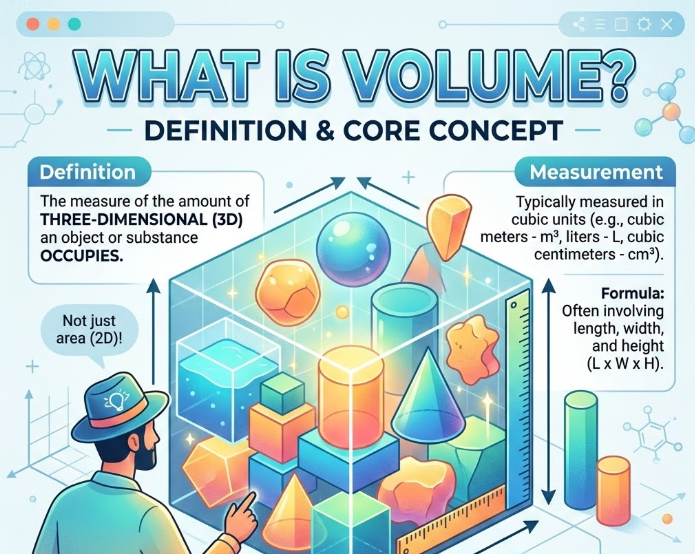
Volume is the quantitative measurement of three-dimensional space enclosed by a surface. Unlike area, which measures flat surfaces, volume accounts for length, width, and height together.
Volume refers to the total three-dimensional space occupied by a solid, liquid, or gas. It is measured in cubic units and represents capacity or spatial extent. Understanding volume requires multiplying dimensions based on the object’s geometric shape.
Key Points About Volume
• Volume is always expressed in cubic units such as cm³, m³, or ft³ because it involves three dimensions multiplied together. This cubic measurement ensures precision in spatial calculations across industries.
• In practical applications, volume may also be expressed in liters or milliliters, particularly when measuring liquids in chemistry or daily life scenarios. One liter equals 1,000 cubic centimeters.
• To accurately calculate volume, all measurements must be in the same unit system. Mixing units (such as inches and meters) leads to incorrect results.
• Volume formulas differ depending on the shape, but they typically involve multiplying a base area by a height. This principle applies to many three-dimensional solids.
• In science and engineering, volume calculations are used to determine material quantities, density, buoyancy, and structural capacity.
• Mastering how to find volume builds a strong foundation for advanced topics like calculus, fluid dynamics, thermodynamics, and architectural design.
Also Read:- How to Train Your Dragon: Homecoming – Complete Guide
How to Find Volume of a Cylinder
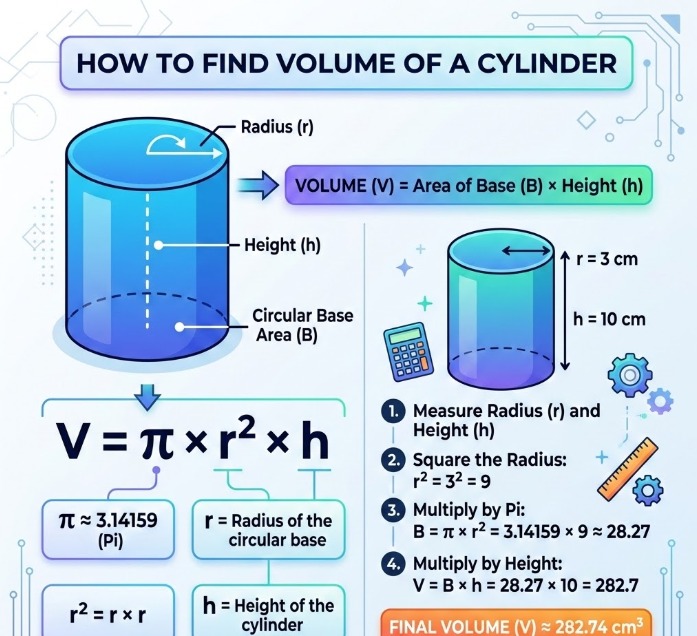
A cylinder is a three-dimensional solid with two parallel circular bases connected by a curved surface. Its volume depends on the area of the circular base and the height. The formula reflects the principle of base area multiplied by height.
Detailed Explanation & Key Points
• The first step in how to find volume of a cylinder is identifying the radius. The radius is half the diameter of the circular base. Accurate measurement is critical for correct results.
• Next, calculate the area of the circular base using πr². This determines how much space one layer of the cylinder occupies before considering height.
• Multiply the base area by the height of the cylinder. This effectively stacks circular layers until reaching the total height.
• If the diameter is given instead of the radius, divide it by two before applying the formula. This avoids calculation errors.
• Example: If radius = 4 cm and height = 10 cm,
V = 3.1416 × 16 × 10 = 502.65 cm³
• Cylinders are common in storage tanks, pipes, batteries, and cans. Understanding this formula is practical for real-world engineering and construction tasks.
Also Read:- How to Wash Locs: The Complete Expert Guide for Healthy, Clean, and Strong Dreadlocks
How to Find Volume of a Cone
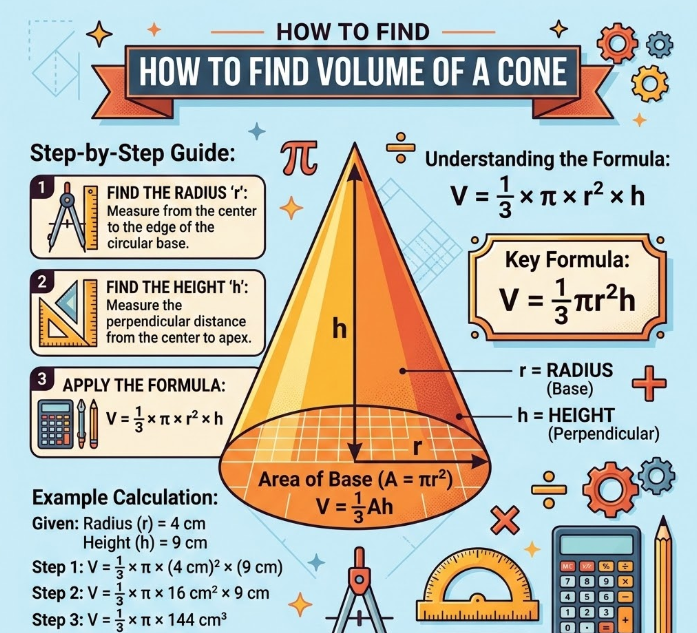
A cone is a three-dimensional shape with a circular base that tapers smoothly to a single point called the vertex. Its volume is one-third of a cylinder with the same base and height. This fraction reflects its narrowing structure.
Detailed Explanation & Key Points
• Begin by calculating the base area using πr², just as with a cylinder. This determines the foundational circular space.
• Multiply the base area by the height of the cone. However, unlike cylinders, cones require division by three.
• The one-third factor exists because a cone occupies exactly one-third the volume of a cylinder with identical base and height
• Cones appear in architecture (towers), food products (ice cream cones), and engineering structures.
• Always ensure the height used is perpendicular from the base to the vertex, not the slant height.
Also Read:- How to Wash Running Shoes: The Complete Expert Guide for Safe, Effective Cleaning
How to Find Volume of a Cube
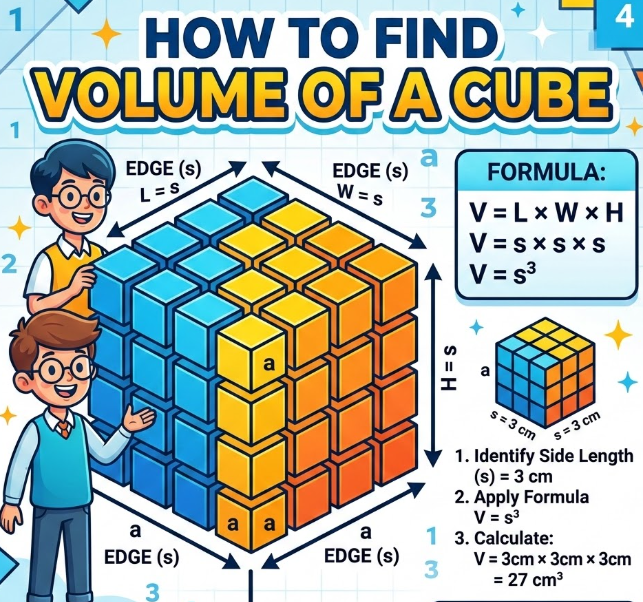
A cube is a three-dimensional solid with six equal square faces. All sides are equal in length. The volume formula is straightforward because all dimensions are identical.
Detailed Explanation & Key Points
• To determine how to find volume of a cube, measure one side only. Since all sides are equal, no additional dimensions are required.
• Multiply the side length by itself three times (a × a × a).
• Example: If side = 5 cm
V = 5³ = 125 cm³
• Cubes are common in packaging, dice, storage boxes, and building blocks.
• Small measurement errors significantly affect results because the value is cubed.
• This formula is foundational in algebra and spatial reasoning development.
Also Read:- How to Water Mums: The Complete Expert Guide for Healthy, Long-Lasting Blooms
How to Find Volume of a Rectangular Prism
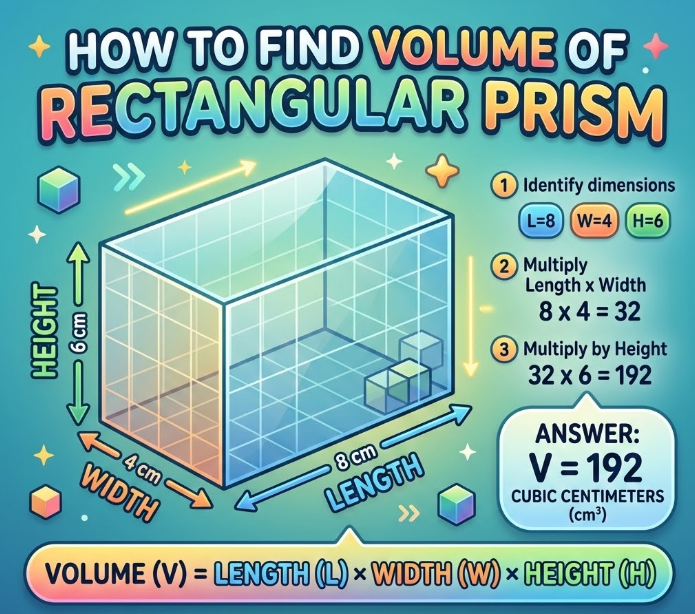
A rectangular prism is a three-dimensional shape with six rectangular faces. It has length, width, and height. Its volume equals the product of these three dimensions.
Detailed Explanation & Key Points
• Measure length, width, and height accurately using consistent units.
• Multiply all three values together to obtain the total cubic space.
• Example: 10 cm × 4 cm × 3 cm = 120 cm³
• Rectangular prisms model rooms, containers, shipping boxes, and buildings.
• This formula is the foundation for calculating capacity in architecture and logistics.
• Always convert units before multiplying if necessary.
Also Read:- How to Make Google My Default Browser: The Complete 2026 Guide
How to Find Volume with Density and Mass
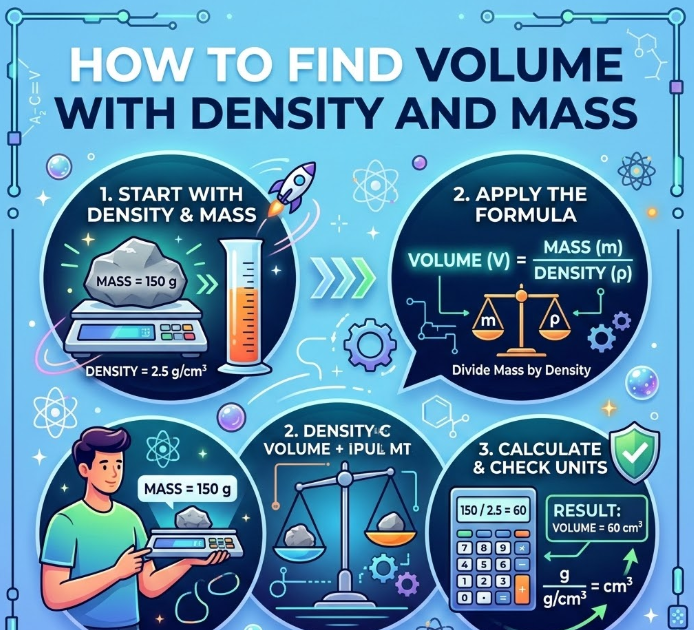
In physics and chemistry, volume can be calculated when density and mass are known. Density represents mass per unit volume. Rearranging the formula allows volume determination.
Key Points
• Density formula: Density = Mass ÷ Volume. Rearranging gives Volume = Mass ÷ Density.
• Example: If mass = 200 g and density = 4 g/cm³
Volume = 50 cm³
• This method is widely used in laboratories and material science.
• Accurate unit consistency is essential (e.g., grams with g/cm³).
• It helps determine unknown object sizes in fluid displacement experiments.
• Essential in engineering material selection and buoyancy calculations.
Also Read:- How to Call Private: The Complete Guide to Hiding Your Caller ID Safely and Legally
How to Find Volume of a Sphere
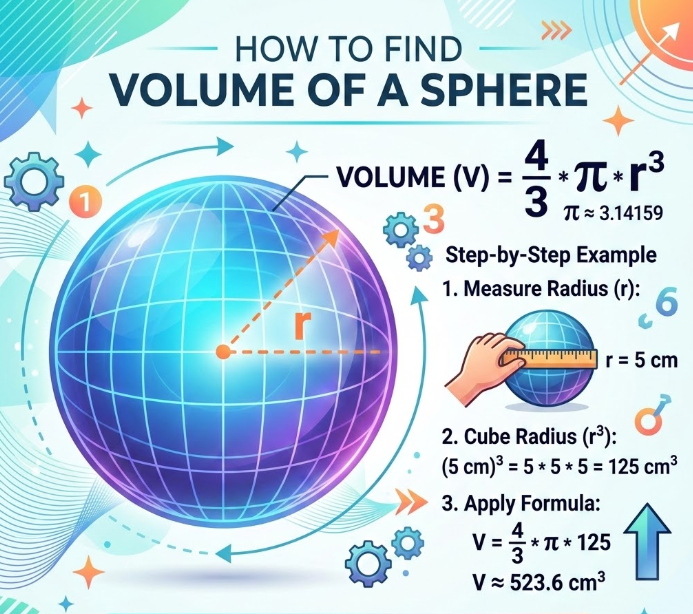
A sphere is a perfectly round three-dimensional object, like a ball. All points on its surface are equidistant from the center. Its volume depends solely on the radius.
Key Points
• Measure the radius from center to surface.
• Cube the radius (r³).
• Multiply by π and then by 4/3.
• Example: r = 6 cm
V ≈ 904.78 cm³
• Spheres model planets, bubbles, sports balls, and droplets.
• Used in astronomy, physics, and fluid mechanics.
Also Read:- How to Braid Hair: The Complete Step-by-Step Guide for Beginners, Men, and Advanced Styles
How to Find Volume of a Triangular Prism
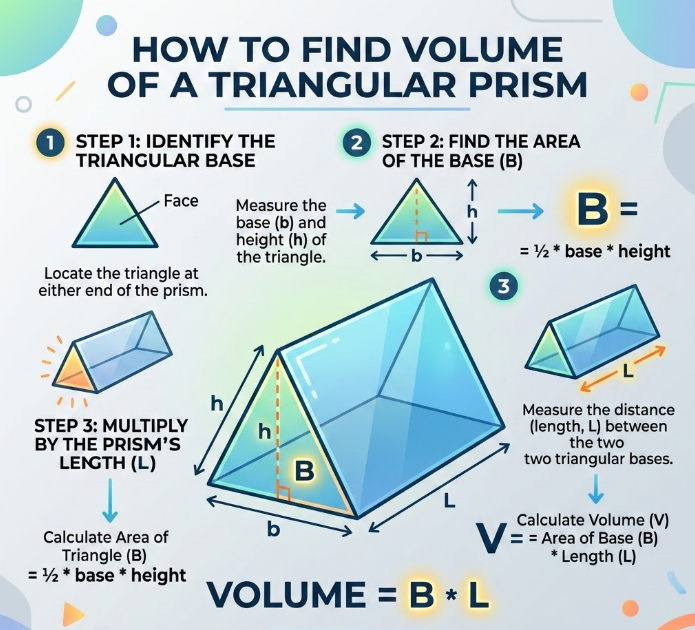
A triangular prism has triangular bases connected by rectangular faces. Its volume equals the triangular base area multiplied by length.
Key Points
• Calculate area of triangle: ½ × base × height.
• Multiply by prism length.
• Example: b = 6 cm, h = 4 cm, l = 10 cm
V = 120 cm³
• Used in roof structures and bridge supports.
• Ensure correct triangle height is used.
• Widely applied in construction design.
Also Read:- How to Get Out of Jury Duty: Legal, Ethical, and Practical Guide
How to Find Volume in Chemistry
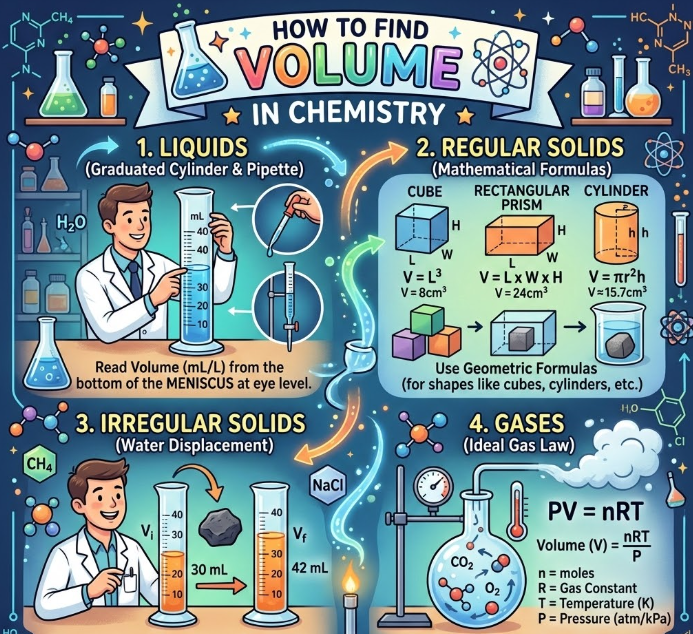
In chemistry, volume refers to the space occupied by gases, liquids, or solids. It is measured using laboratory tools. Calculations often involve density or gas laws.
Key Points
• Liquids are measured using graduated cylinders or burettes.
• Gas volume can be calculated using Ideal Gas Law: PV = nRT.
• Solid volume may be found using water displacement.
• Volume is essential in molarity calculations.
• Accurate lab measurements require temperature and pressure control.
• Unit conversions (mL to L) are critical for precision.
Also Read:- How to Find Surface Area: Complete Step-by-Step Guide with Formulas and Examples
Conclusion
Mastering how to find volume equips you with a vital mathematical skill applicable across academics and professional fields. From simple cubes to complex chemistry calculations, volume formulas allow precise measurement of three-dimensional space. By understanding each shape’s formula and practicing consistently, you build analytical confidence and real-world problem-solving abilities.
FAQs
What is the easiest shape to calculate volume for?
The cube is simplest because all sides are equal.
Why is cone volume divided by 3?
Because a cone occupies one-third of a cylinder with same base and height.
What unit is commonly used for liquid volume?
Liters and milliliters.
How is volume used in real life?
Construction, engineering, medicine, cooking, and scientific research.
For More Updates Visit: Biomagazine
