

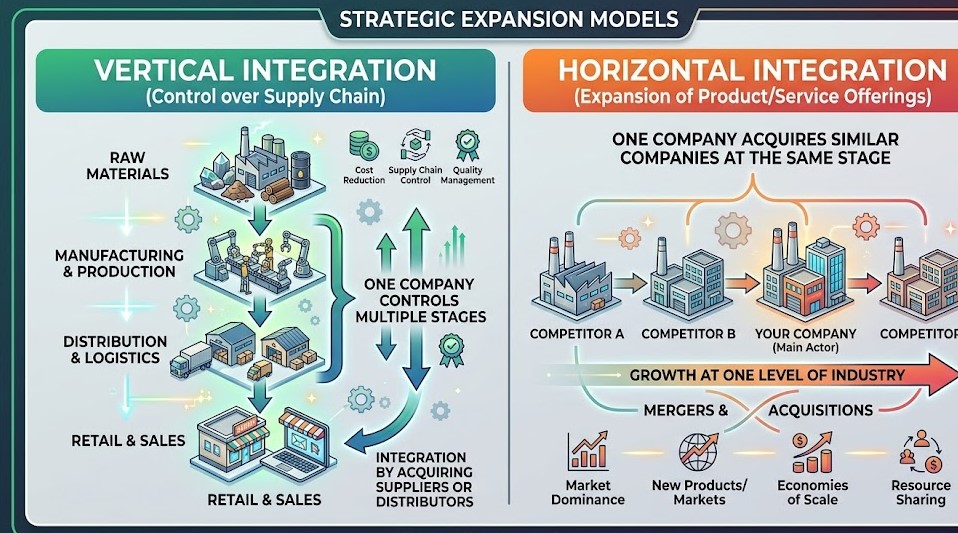
Vertical integration is a business strategy where a company expands by taking control of different stages of its supply chain, such as production, suppliers, or distribution. Instead of relying on outside businesses for materials or services, the company manages more processes internally. This approach helps organizations improve control over quality, reduce costs, and ensure smoother operations from start to finish. Businesses often use vertical integration to become more self-reliant and reduce risks caused by external dependencies.
Companies can adopt vertical integration in two main ways: backward integration and forward integration. Backward integration happens when a business acquires or develops control over its suppliers, such as a clothing brand owning a textile factory. Forward integration occurs when a company moves closer to the customer by controlling distribution channels or retail stores. Both methods help strengthen control over the supply chain and improve efficiency, but they also require significant investment and management resources.
What is Horizontal Integration?
Horizontal integration is a business strategy where a company grows by merging with or acquiring other companies that operate at the same level of the industry. Instead of moving up or down the supply chain, the business expands sideways by joining forces with competitors or similar organizations. The main goal of this strategy is to increase market share, reduce competition, and strengthen overall market presence.
This approach is commonly used when companies want to quickly scale their operations or enter new geographic markets without building everything from scratch. For example, if a supermarket chain acquires another supermarket brand, it is practicing horizontal integration. This strategy can lead to stronger brand recognition, larger customer bases, and improved economies of scale. However, it may also raise regulatory concerns if it reduces competition too much in the market.
Key Differences Between Vertical and Horizontal Integration
The main difference between vertical and horizontal integration lies in how a company expands its business operations. Vertical integration focuses on controlling different stages of the supply chain, while horizontal integration focuses on expanding at the same level of the industry by acquiring competitors. Both strategies aim to improve business growth, but they operate in completely different directions and serve different strategic purposes.
In vertical integration, a company may take control of suppliers or distributors to improve efficiency and reduce dependency on third parties. In contrast, horizontal integration is used to increase market share by combining with or acquiring similar companies. Vertical integration strengthens internal operations, while horizontal integration strengthens market position. For example, a car manufacturer owning its parts supplier represents vertical integration, whereas that same manufacturer acquiring another car brand represents horizontal integration.
Advantages of Vertical Integration
Vertical integration offers several advantages that can significantly improve a company’s control over its operations. One of the biggest benefits is greater efficiency in the supply chain, as businesses can manage production, distribution, and supply processes under one system. This reduces delays, improves coordination, and ensures better quality control throughout the entire production process.
Another major advantage is cost reduction in the long run. Although vertical integration requires heavy initial investment, it can eliminate middleman costs and reduce dependency on external suppliers. Companies also gain more stability during supply shortages or market disruptions because they control key stages of production. Additionally, it allows businesses to protect their proprietary technology and maintain stronger competitive advantages in the industry.
Advantages of Horizontal Integration
Horizontal integration provides companies with the ability to grow quickly and strengthen their position in the market. One of the main advantages is the increase in market share, as businesses combine forces with competitors to serve a larger customer base. This expansion helps companies become more dominant in their industry and improves brand visibility.
Another important benefit is economies of scale, where larger operations lead to lower production costs per unit. By merging with or acquiring similar companies, businesses can reduce competition and improve efficiency in marketing, production, and distribution. Horizontal integration also helps companies enter new geographic markets more easily, allowing faster expansion without building operations from scratch. However, while it offers strong growth opportunities, it may also lead to regulatory challenges if it creates monopolistic conditions.
Real-World Case Studies
Real-world examples help clearly show how vertical vs horizontal integration works in practice. Many global companies have successfully used these strategies to grow their businesses and strengthen their market position.
A well-known example of vertical integration is Apple. The company designs its own hardware and software and also controls key parts of its ecosystem, such as retail stores and digital services. This allows Apple to maintain strict control over product quality, user experience, and brand consistency. By managing multiple stages of its value chain, Apple reduces dependency on external suppliers and creates a highly integrated system.
On the other hand, horizontal integration can be seen in Facebook’s acquisition of Instagram and WhatsApp. These platforms operate in similar social media markets, and by acquiring them, Facebook expanded its user base and reduced competition. This strategy helped the company dominate the social networking space and strengthen its advertising business. However, such moves also attract regulatory attention due to concerns about market dominance and reduced competition.
When Businesses Use Each Strategy
Companies choose between vertical and horizontal integration depending on their goals, market conditions, and available resources. Vertical integration is usually preferred when a business wants to gain more control over its supply chain, improve quality assurance, or reduce dependency on external suppliers. It is commonly used in industries where production delays or supply disruptions can significantly impact performance, such as manufacturing, technology, and automotive sectors.
Horizontal integration, on the other hand, is used when companies aim to grow quickly, increase market share, or eliminate competition. It is often seen in highly competitive industries where businesses want to strengthen their position by merging with or acquiring similar companies. This strategy is especially useful when entering new regions or scaling operations rapidly without building new infrastructure from the ground up. However, companies must carefully consider legal and regulatory risks, as large-scale mergers can attract antitrust scrutiny.
Conclusion
Understanding vertical vs horizontal integration is essential for grasping how modern businesses grow and compete in today’s global economy. Vertical integration focuses on controlling different stages of the supply chain to improve efficiency, reduce costs, and ensure better quality control. In contrast, horizontal integration aims to expand market share by acquiring or merging with competitors operating at the same level. Both strategies offer unique advantages and challenges, and companies choose them based on their long-term goals, industry conditions, and competitive environment.
Ultimately, vertical integration is about control and efficiency, while horizontal integration is about growth and dominance. Businesses that use these strategies effectively can strengthen their market position, improve profitability, and build long-term sustainability. However, success depends on careful planning, strong execution, and awareness of potential risks such as high costs or regulatory restrictions.
FAQs
What is the main difference between vertical and horizontal integration?
Vertical integration controls the supply chain, while horizontal integration focuses on acquiring competitors at the same level.
Which is better: vertical or horizontal integration?
It depends on business goals—vertical improves control and efficiency, while horizontal increases market share and growth.
Why do companies use horizontal integration?
Companies use it to expand quickly, reduce competition, and enter new markets more easily.
What are the risks of vertical integration?
High investment costs, management complexity, and reduced flexibility can be major risks.
For More Updates Visit: Biomagazine
