

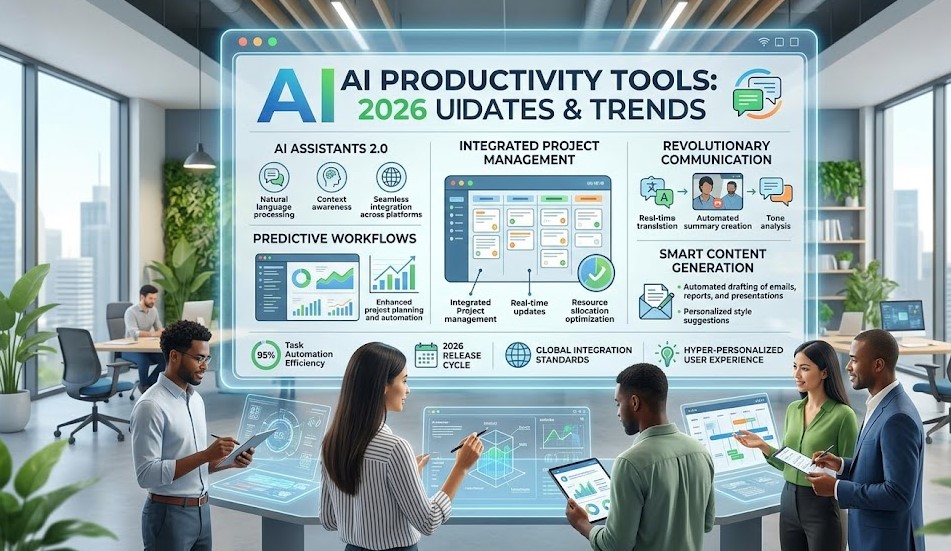
The biggest change in ai productivity tools updates 2026 is the rapid rise of AI workspace agents. Unlike traditional AI chatbots that only answer questions, workspace agents can now perform complete tasks across multiple applications. Companies like OpenAI, Microsoft, and Google are developing AI systems that connect directly with email platforms, project management software, calendars, cloud storage, and communication tools. These agents can organize meetings, generate reports, summarize conversations, and even automate repetitive workflows without requiring constant human input. Businesses are increasingly adopting these tools because they reduce manual work and improve overall efficiency in remote and hybrid work environments.
Modern AI workspace agents are also becoming more context-aware and personalized. Instead of responding to single prompts, they can remember ongoing tasks, understand workplace priorities, and coordinate activities between teams. For example, an AI agent can analyze Slack conversations, create action items, update project dashboards, and schedule follow-up meetings automatically. This shift is transforming productivity software from simple assistance tools into intelligent digital coworkers. As competition between tech companies grows, AI workspace agents are expected to become one of the most important innovations shaping the future of workplace productivity in 2026.
Microsoft Copilot’s Biggest Productivity Improvements
Microsoft has made significant advancements in its Copilot ecosystem, making it one of the most powerful workplace AI systems in 2026. Integrated directly into Word, Excel, PowerPoint, Outlook, and Teams, Copilot helps users complete tasks faster by generating content, analyzing data, and automating repetitive office work. One of the most notable updates includes advanced spreadsheet intelligence in Excel, where AI can now detect patterns, create visual reports, and suggest formulas automatically. In Word and Outlook, Copilot assists with drafting professional documents, summarizing long emails, and improving communication efficiency for businesses of all sizes.
Another major improvement is Microsoft Copilot’s deeper collaboration features within Teams. Employees can now receive real-time meeting summaries, action-item tracking, and AI-generated follow-up tasks immediately after virtual meetings. This reduces time spent reviewing recordings or manually taking notes during discussions. Microsoft has also enhanced security and enterprise controls, allowing organizations to manage AI-generated content more safely within corporate environments. These updates demonstrate how Microsoft is positioning Copilot as a central productivity assistant that works across the entire Microsoft 365 ecosystem, helping professionals save time while improving workflow organization and decision-making.
Google Gemini and Smart Workspace Automation
Google Gemini has become one of the most advanced AI-powered productivity systems in 2026, especially for users who rely on Google Workspace applications. Integrated into Gmail, Docs, Sheets, Meet, and Drive, Gemini helps users automate routine tasks while improving collaboration and content management. One of its most useful features is smart email organization in Gmail, where AI can summarize long conversations, draft replies, prioritize important messages, and schedule meetings automatically. In Google Docs, Gemini assists with writing, editing, formatting, and content suggestions, allowing teams to create professional documents much faster than before.
Another major development is Gemini’s automation capabilities inside Google Sheets and Meet. The AI system can analyze complex spreadsheet data, generate charts, explain trends, and even provide predictive insights for business planning. During video meetings, Gemini can create live transcripts, identify action items, and generate concise meeting summaries for participants. These features are especially valuable for remote teams and businesses handling large amounts of information daily. As part of the ongoing ai productivity tools updates 2026, Google is focusing heavily on making AI feel seamlessly integrated into existing workflows instead of functioning as a separate application, helping users stay productive without constantly switching between tools.
AI Meeting Assistants Are Replacing Manual Notes
AI meeting assistants have become a core part of modern workplace productivity in 2026, significantly reducing the need for manual note-taking during online and in-person meetings. Tools powered by advanced AI can now record conversations, transcribe speech in real time, and automatically summarize key discussion points. Instead of relying on employees to take notes, these systems generate structured summaries that highlight decisions, deadlines, and action items immediately after the meeting ends. This shift is saving teams a considerable amount of time and improving accuracy in communication.
These AI tools are also becoming smarter at understanding context and speaker intent. They can identify important topics, track who is responsible for tasks, and even detect follow-up requirements without manual input. Many organizations are integrating these assistants directly into platforms like Zoom, Microsoft Teams, and Google Meet, making the process seamless. As part of ai productivity tools updates 2026, this innovation is especially valuable for remote teams, where clear documentation and fast communication are essential. By automating meeting documentation, businesses can focus more on decision-making and less on administrative tasks.
Notion AI and the Evolution of Team Collaboration
Notion AI has evolved into a powerful all-in-one collaboration platform in 2026, transforming how teams manage knowledge, projects, and documentation. Instead of acting only as a note-taking tool, it now functions as a full productivity hub where AI helps users generate content, organize databases, and structure entire workflows. Teams can create project plans, meeting notes, content calendars, and internal documentation with AI assistance, reducing the time spent on manual formatting and planning. This has made Notion a preferred choice for startups, creators, and remote teams looking for a flexible workspace.
A major improvement in Notion AI is its ability to understand organizational context. It can now pull information from different pages, summarize project progress, and suggest updates based on team activity. For example, if a project is delayed, the AI can highlight bottlenecks and recommend next steps. This makes collaboration more transparent and efficient across departments. As part of ai productivity tools updates 2026, Notion AI reflects a broader shift toward unified digital workspaces where documentation, planning, and automation all exist in one intelligent system.
AI Automation Tools Saving Businesses Time
AI automation tools have become a major driver of efficiency in 2026, especially for businesses looking to reduce repetitive manual work. These tools are designed to connect different apps and workflows so that tasks can be completed automatically without human intervention. For example, businesses can now automate lead generation, customer support responses, invoice processing, and data entry across multiple platforms. This has significantly reduced operational workload and allowed employees to focus more on strategic decision-making rather than routine tasks.
Another important development is the rise of no-code and low-code automation platforms powered by AI. These systems allow even non-technical users to create complex workflows using simple prompts. Businesses can link CRM systems, email marketing tools, and project management software into a single automated pipeline. As part of ai productivity tools updates 2026, this trend is helping small and medium-sized businesses compete with larger enterprises by giving them access to advanced automation without needing large technical teams. The result is faster execution, lower costs, and improved productivity across industries.
Security and Privacy Concerns in AI Productivity Tools
As ai productivity tools updates 2026 continue to evolve, security and privacy have become major concerns for both individuals and organizations. Since AI systems now handle sensitive data such as emails, business documents, financial reports, and internal communications, the risk of data exposure or misuse has increased. Companies are therefore focusing heavily on building stronger encryption, access controls, and data governance frameworks to ensure that AI tools operate safely within enterprise environments. Without proper safeguards, even the most advanced productivity systems can become a liability.
Another key issue is how AI models store and process user data. Many organizations worry about whether their confidential information is being used to train external models or shared across platforms unintentionally. In response, major tech providers are introducing enterprise-grade privacy controls, allowing businesses to restrict data usage and maintain full ownership of their information. Regulations and compliance standards are also becoming stricter, pushing companies to be more transparent about how AI handles sensitive content. This balance between productivity and privacy is now one of the most important challenges shaping the future of AI-powered work tools.
Future Trends in AI Productivity Tools
The future of ai productivity tools updates 2026 points toward even more intelligent, autonomous, and deeply integrated systems. One of the biggest trends is the shift from simple AI assistants to fully autonomous AI agents that can complete entire projects with minimal human supervision. These agents will not only assist with tasks but also plan, execute, and optimize workflows across multiple platforms, making them true digital coworkers in modern workplaces. Businesses are expected to rely more on these systems to handle operations such as reporting, customer management, and strategic analysis.
Another emerging trend is hyper-personalized AI productivity environments. Instead of one-size-fits-all tools, future AI systems will adapt to each user’s working style, preferences, and goals. This means dashboards, workflows, and recommendations will be uniquely tailored to individuals and teams. Additionally, integration between AI and emerging technologies like augmented reality and voice-first computing is expected to grow. Workers may soon interact with productivity systems through natural speech or immersive interfaces. Overall, the direction of AI productivity tools is moving toward seamless, intelligent, and highly adaptive ecosystems that redefine how work gets done.
Conclusion
The landscape of ai productivity tools updates 2026 clearly shows that artificial intelligence has moved far beyond simple assistance and is now reshaping the entire concept of work. From AI workspace agents to advanced automation systems, every major platform is focused on reducing manual effort and improving efficiency. Tools like Microsoft Copilot, Google Gemini, and Notion AI are no longer optional add-ons—they are becoming core components of daily workflows in businesses and organizations worldwide.
As AI continues to evolve, productivity is shifting toward smarter, faster, and more automated systems that help people focus on meaningful tasks instead of repetitive work. However, this transformation also brings challenges, especially in areas like privacy, security, and responsible data use. Overall, the future of workplace productivity is clearly AI-driven, and 2026 marks a major turning point in how humans and machines collaborate to get work done.
FAQs
1. What are AI productivity tools in 2026?
AI productivity tools in 2026 are advanced software systems that automate tasks like writing, scheduling, meetings, data analysis, and workflow management using artificial intelligence.
2. Which AI productivity tools are most popular in 2026?
Popular tools include Microsoft Copilot, Google Gemini, Notion AI, ChatGPT, Grammarly AI, and various AI automation platforms.
3. How do AI productivity tools improve work efficiency?
They save time by automating repetitive tasks, generating content, summarizing information, and improving communication and collaboration.
4. Are AI productivity tools safe to use?
Yes, but safety depends on the platform. Most major providers now include strong encryption and enterprise-level privacy controls to protect user data.
For More Updates Visit: Biomagazine
