

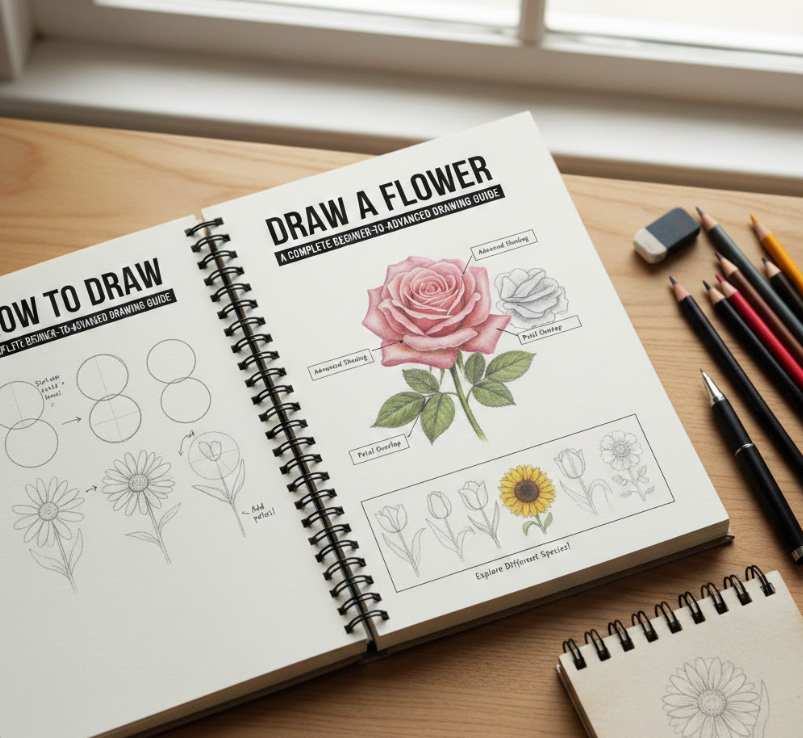
Drawing flowers is one of the most enjoyable and rewarding ways to learn art. Flowers appear simple at first glance, yet they offer endless variety in shapes, textures, and details, making them perfect for beginners and experienced artists alike. If you’re searching for how to draw a flower, you’re likely looking for clear guidance that builds confidence while improving artistic skills.
This comprehensive guide explains how to draw a flower in multiple styles—from easy sketches to realistic illustrations and full bouquets. Based on foundational art principles, observational drawing techniques, and real artistic practice, this article helps you understand not just what to draw, but why each step matters. By the end, you’ll have the skills and confidence to draw flowers that look natural, balanced, and expressive.
Why Learning to Draw Flowers Improves Your Art Skills
Flowers teach essential drawing fundamentals such as symmetry, proportion, shading, and line control. According to art education studies, beginners who practice organic forms like flowers develop observational skills faster than those who start with rigid geometric objects.
Flowers also train patience and attention to detail. Each petal, stem, and leaf contributes to the overall form, making floral drawing an excellent foundation for still life, nature illustration, and even character design.
How to Draw a Flower Easy
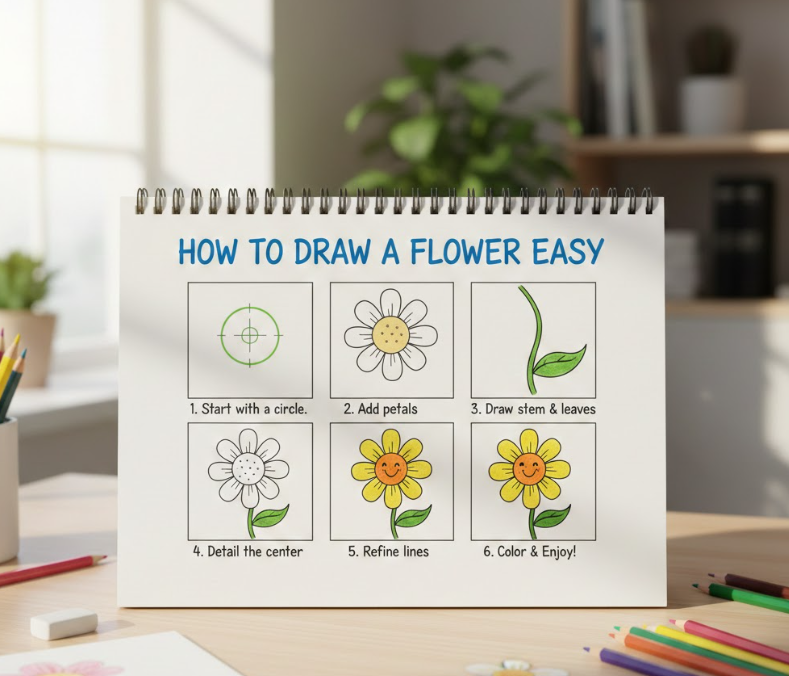
This method focuses on simplifying shapes and reducing complexity so beginners can enjoy drawing without feeling overwhelmed.
What “Easy Flower Drawing” Really Means
An easy flower drawing breaks complex forms into basic shapes, allowing beginners to focus on flow and balance rather than perfection.
Beginner-Friendly Drawing Process
• Start with simple shapes as a base
Instead of jumping into details, begin by drawing a small circle for the flower center. Around it, lightly sketch oval or teardrop shapes to represent petals. This approach helps establish balance before refining the form.
• Use light pencil pressure
Drawing lightly allows you to adjust shapes without leaving harsh marks. Artists often sketch initial guidelines softly so corrections feel natural and stress-free.
• Keep petal shapes consistent but not identical
Real flowers are imperfect. Slight variation in petal size and angle adds realism even in simple drawings, making the flower feel more organic.
• Add a basic stem and leaves
A straight or gently curved line works well for the stem. Leaves can be drawn using simple almond shapes to maintain simplicity.
• Avoid excessive detail at this stage
Easy flower drawings focus on form rather than texture. Skipping shading and intricate lines keeps the process enjoyable for beginners.
• Refine outlines once satisfied
After the basic structure looks balanced, darken the final lines. This step transforms rough sketches into clean, finished drawings.
Also Read:- How to Start a Blog and Make Money: A Complete Beginner-to-Expert Guide
How to Draw a Flower Step by Step
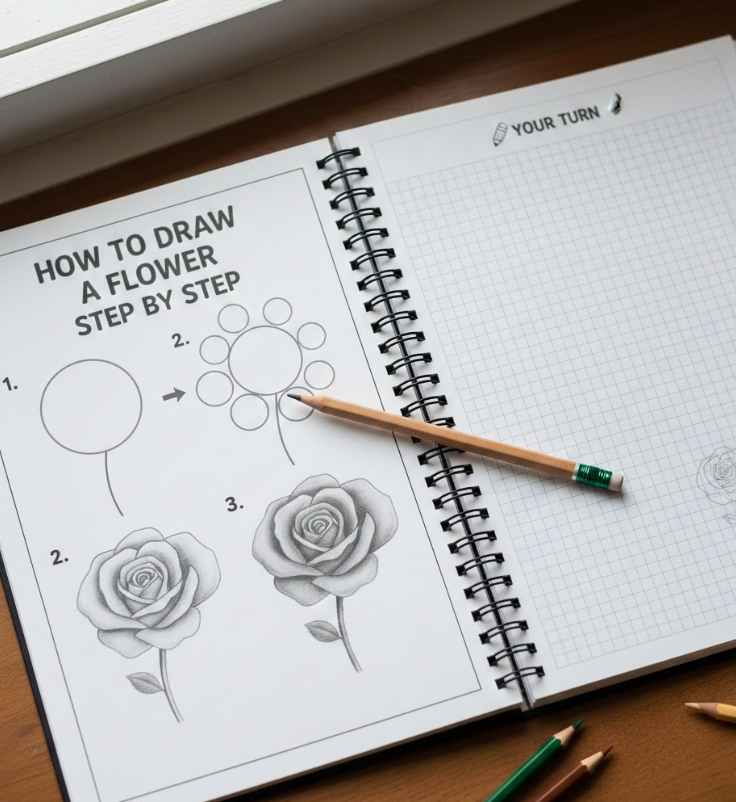
A step-by-step approach helps artists understand structure, proportion, and progression, making complex drawings manageable.
Why Step-by-Step Drawing Works
Breaking the process into stages allows your brain to focus on one task at a time, reducing frustration and improving accuracy.
Structured Drawing Method
• Observe reference images carefully
Before drawing, study real flowers or photos. Notice how petals overlap, where shadows fall, and how stems connect to the bloom.
• Sketch construction lines first
Light guidelines help define symmetry and direction. A vertical line can guide stem placement, while radial lines help space petals evenly.
• Block in major shapes
Using circles, ovals, and curves, define the main flower structure. This stage focuses on proportion rather than detail.
• Develop petal layers gradually
Many flowers have layered petals. Drawing from the back layer forward adds depth and realism to the illustration.
• Add contour lines and texture
Gentle lines within petals suggest folds and veins. These subtle details bring dimension without overwhelming the drawing.
• Finalize with shading and cleanup
Erase unnecessary guidelines and add light shading to suggest depth. This step gives the flower a polished, complete look.
Also Read:- How to Cook Lobster Tail: A Complete Expert Guide for Perfect Results
How to Draw a Flower Bouquet
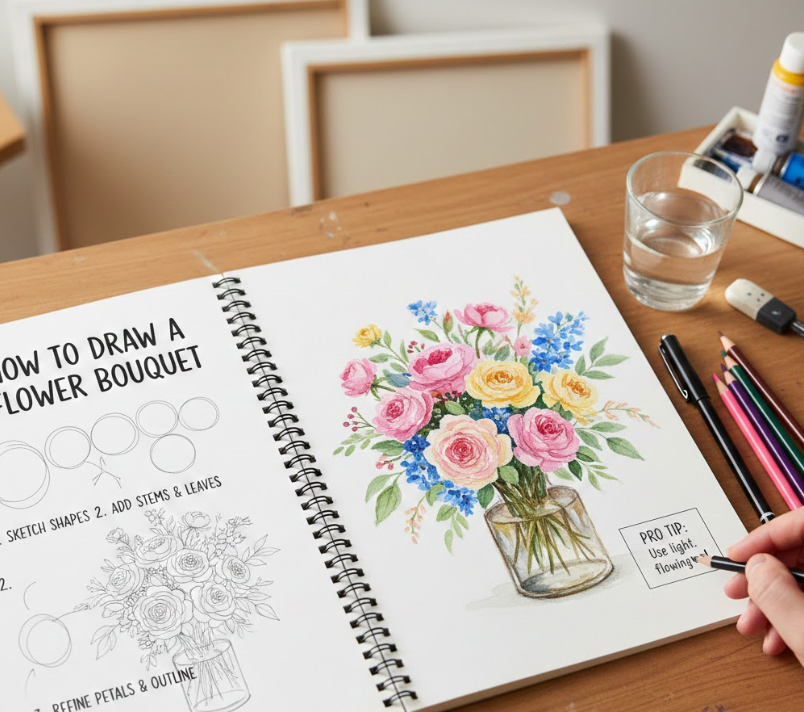
Drawing a bouquet requires understanding composition, overlap, and visual balance rather than focusing on a single bloom.
Understanding Bouquet Composition
A bouquet is a collection of flowers arranged to guide the viewer’s eye. Successful bouquet drawings rely on layering and flow.
Bouquet Drawing Techniques
• Plan the bouquet shape first
Lightly sketch an overall shape, such as a dome or oval. This acts as a container for the flowers and keeps the composition balanced.
• Draw flowers at different angles
Not every flower should face forward. Angled blooms create depth and make the bouquet appear more natural.
• Overlap flowers intentionally
Overlapping elements prevent the bouquet from looking flat. Foreground flowers should have stronger lines than background blooms.
• Vary flower sizes and types
Mixing large and small flowers adds visual interest. Uniform shapes can make bouquets feel stiff and unrealistic.
• Add connecting stems and filler leaves
Stems, leaves, and small filler flowers tie the bouquet together visually, creating cohesion.
• Refine details gradually
Avoid detailing every flower equally. Focus detail on focal blooms and keep others simpler to maintain balance.
Also Read:- How to Hide Apps on iPhone (Complete Privacy & Organization Guide)
How to Draw a Flower Realistic
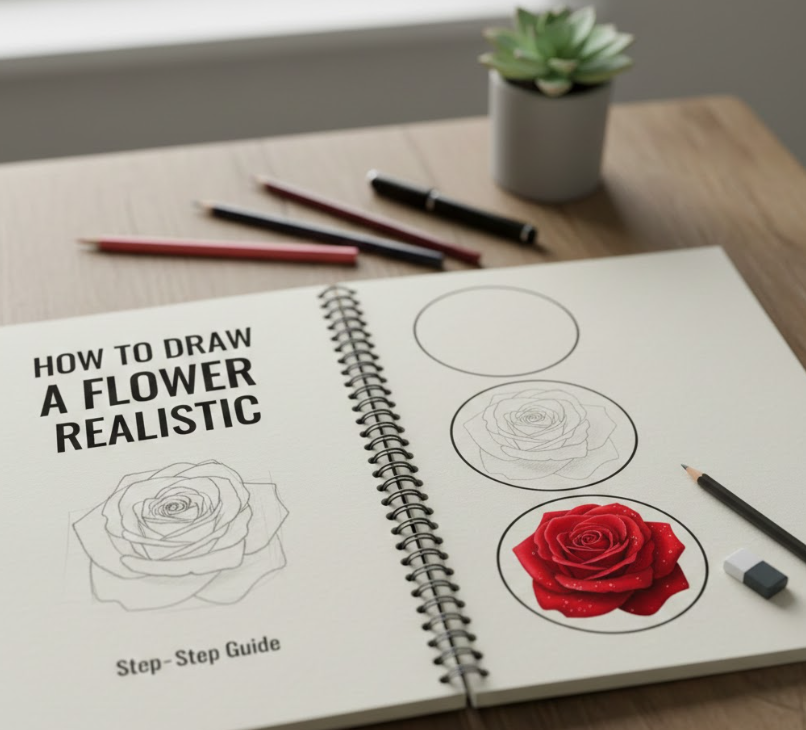
Realistic flower drawing emphasizes accurate proportions, light, texture, and subtle color variation.
What Makes a Flower Look Realistic
Realism comes from observation, patience, and understanding how light interacts with organic forms.
Realistic Drawing Techniques
• Study real flowers closely
Observe petal thickness, edges, and natural curves. Real flowers often have irregular shapes that add authenticity.
• Use layered shading techniques
Gradual shading builds depth. Light pressure and multiple layers create smooth transitions between light and shadow.
• Pay attention to light source
Knowing where light comes from helps place shadows correctly. This adds three-dimensional form to petals and leaves.
• Add fine details selectively
Veins, tiny folds, and subtle imperfections enhance realism. Over-detailing, however, can make drawings look heavy.
• Blend carefully for smooth textures
Blending tools or soft pencil strokes help create delicate petal textures without harsh lines.
• Practice patience and refinement
Realistic drawings take time. Stepping back frequently helps spot proportion errors before finalizing details.
Also Read:- How to Find Horizontal Asymptotes (Complete Step-by-Step Guide)
Conclusion
Learning how to draw a flower is more than an artistic exercise—it’s a way to develop patience, observation, and creative confidence. Whether you begin with easy sketches, follow step-by-step methods, explore bouquet compositions, or aim for realism, each approach strengthens your skills in unique ways.
Frequently Asked Questions
Is drawing flowers good for beginners?
Yes. Flowers teach shape control, shading, and observation without complex anatomy.
How long does it take to learn realistic flower drawing?
With regular practice, noticeable improvement often appears within a few weeks.
Do I need expensive tools to draw flowers?
No. A simple pencil and paper are enough to start and improve significantly.
For More Updates Visit: Biomagazine
