

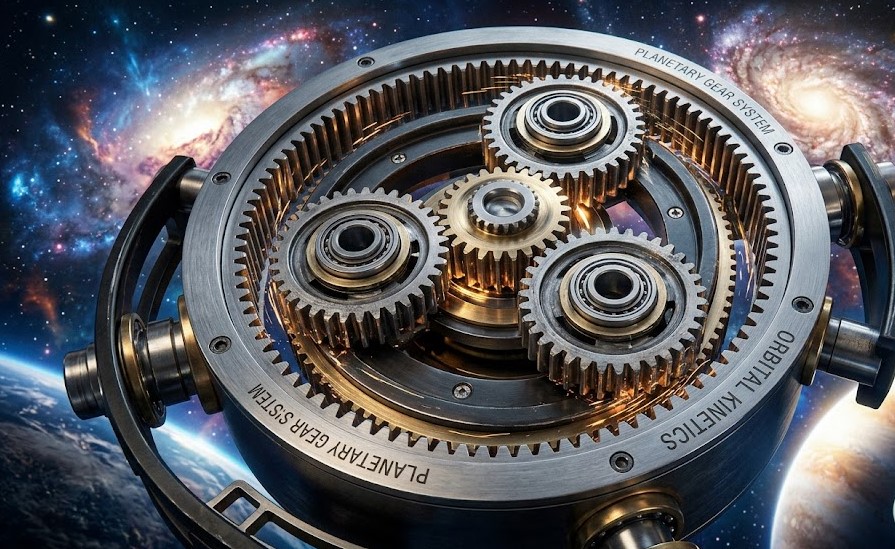
A planetary gears system is built around three primary elements: the sun gear, planet gears, and ring gear, all working together in a compact arrangement. The sun gear sits at the center and acts as the main driver of motion, while multiple planet gears rotate around it and simultaneously mesh with the outer ring gear. This unique configuration allows power to be distributed evenly, reducing stress on individual components and improving overall durability. The planet gears are mounted on a carrier, which holds them in position and can act as either input or output depending on the system design. This structure makes planetary gears highly efficient for high-torque applications where space is limited.
Working Principle of Planetary Gears
The working principle of planetary gears is based on simultaneous rotation and revolution, similar to how planets move in the solar system. When the sun gear rotates, it drives the planet gears, which then rotate on their own axes while also revolving inside the ring gear. Depending on which component is fixed, input, or output, the system can produce different speed and torque outputs. This flexibility is what makes planetary systems so valuable in engineering. By adjusting which part remains stationary, engineers can achieve speed reduction, speed increase, or torque multiplication, making planetary gears extremely adaptable in mechanical design.
Types of Planetary Gear Systems
There are several types of planetary gears systems used in modern machinery, each designed for specific applications and performance requirements. The most common types include simple planetary gear sets, compound planetary systems, and differential planetary gears. A simple system consists of one sun gear, one ring gear, and planet gears, while compound systems use multiple gear sets for higher torque and complex motion control. Differential planetary systems allow power splitting and combining, commonly used in automotive differentials. These variations of planetary gears provide engineers with flexibility to design systems that meet specific speed, load, and efficiency requirements.
Advantages of Planetary Gears in Modern Engineering
One of the biggest advantages of planetary gears is their ability to deliver high torque in a compact space. Since multiple planet gears share the load, stress is distributed evenly, resulting in improved durability and longer service life. Another key advantage is their high efficiency, as the coaxial design reduces energy loss during transmission. Additionally, planetary systems offer smooth operation with minimal vibration, making them ideal for precision machinery. Their compact structure also allows engineers to design smaller and lighter machines without sacrificing power, which is why planetary gears are widely used in advanced engineering systems.
Applications Across Industries
Planetary gears are used in a wide range of industries due to their versatility and efficiency. In the automotive sector, they are a core component of automatic transmissions, helping vehicles shift smoothly between speeds. In robotics, they provide precise motion control and high torque in small robotic joints. Industrial machinery relies on them for heavy-duty operations such as conveyors and mixers. They are also essential in aerospace systems, where compact and lightweight designs are critical. Even renewable energy systems like wind turbines use planetary gears to efficiently transfer energy from blades to generators.
Design Considerations and Limitations
While planetary gears offer many benefits, their design also comes with certain considerations and limitations. Precision manufacturing is required to ensure proper alignment between sun, planet, and ring gears, which can increase production costs. Lubrication is also critical, as high contact between gear surfaces can lead to wear if not properly maintained. Additionally, complex assembly and repair processes make them more challenging compared to simpler gear systems. Despite these limitations, engineers continue to use planetary gears because their performance advantages often outweigh the challenges in modern applications.
Future Trends in Planetary Gear Technology
The future of planetary gears is closely linked with advancements in automation, electric vehicles, and robotics. Engineers are focusing on improving efficiency through advanced materials such as lightweight alloys and composites that reduce friction and increase durability. Additive manufacturing (3D printing) is also being explored to create more complex and precise gear structures. In electric vehicles, compact planetary gear systems are becoming essential for improving power efficiency and range. As industries continue to demand smaller, faster, and more efficient machines, planetary gears will remain a key focus in mechanical innovation.
Conclusion
Planetary gears are a powerful and efficient mechanical solution widely used across modern engineering fields. Their unique structure allows high torque transmission, compact design, and smooth operation, making them essential in automotive, robotics, aerospace, and industrial systems. Despite some design complexity, their advantages in performance and efficiency make them one of the most important gear systems in engineering today.
FAQs
1. What are planetary gears used for?
They are used to transmit power efficiently in cars, robotics, and industrial machinery.
2. Why are planetary gears efficient?
Because they distribute load across multiple gears, reducing stress and energy loss.
3. What are the main parts of a planetary gear system?
Sun gear, planet gears, ring gear, and planet carrier.
4. Where are planetary gears commonly found?
In automatic transmissions, wind turbines, robotics, and aerospace systems.
For More Updates Visit: Biomagazine
